How to Use Stock Volume as a Trading Signal?

Here’s what people don’t get. Price can go anywhere. Up, down, sideways. But volume tells you if anybody actually believes in that move. That’s the difference between real price action and noise.
You’ll see a stock break above a key level. Looks perfect on the chart. But if the volume bar is flat? It’s going to fail. Probably today. Maybe tomorrow.
But it fails. Why? Because nobody’s actually buying. It’s just a few random orders floating through.
Now flip it. Same breakout, but this time volume explodes. Institutions stepped in. Real money moved. That breakout sticks.
Volume’s your reality check. It tells you if what you’re seeing on the chart is actually happening or if you’re just looking at illusion. Most traders never learn this. They chase price. They get destroyed.
What Is Stock Volume?
Stock volume refers to the number of shares traded over a specific period, whether that’s a minute, an hour, a day, or even a week.
For example, if a stock records a daily volume of 10 million shares, that means 10 million shares were bought and sold during that trading session. While volume doesn’t reveal whether buyers or sellers are in control, it does show how much interest there is in a stock at any given time.
Should beginner traders pay attention to volume?
Absolutely. Volume is one of the easiest indicators to understand and can help beginners identify stronger trends, avoid weak breakouts, and gain a better understanding of market activity.
How to Use Stock Volume as a Trading Signal overview
- Why Volume Matters in Trading
- How Stock Volume Works as a Trading Signal
- Bullish and Bearish Volume Signals
- Using Volume to Confirm Breakouts
- Using Volume to Spot False Breakouts
- Key Volume Indicators Traders Actually Use
- How to Use Volume in a Trading Strategy
- Common Mistakes When Using Stock Volume
- Is High Volume Always Bullish?
- Conclusion
Why Volume Matters in Trading

Volume gives traders valuable context behind price movements.
A stock can climb higher, but if only a small number of traders are participating, the move may lack conviction and could quickly lose momentum. On the other hand, when price rises alongside strong volume, it often signals broader market interest and stronger confidence in the move.
Many traders use volume to help answer questions such as:
- Is this breakout likely to hold?
- Is the current trend gaining momentum?
- Are buyers or sellers becoming more aggressive?
- Is the trend starting to lose strength?
- Could a reversal be forming?
How Stock Volume Works as a Trading Signal
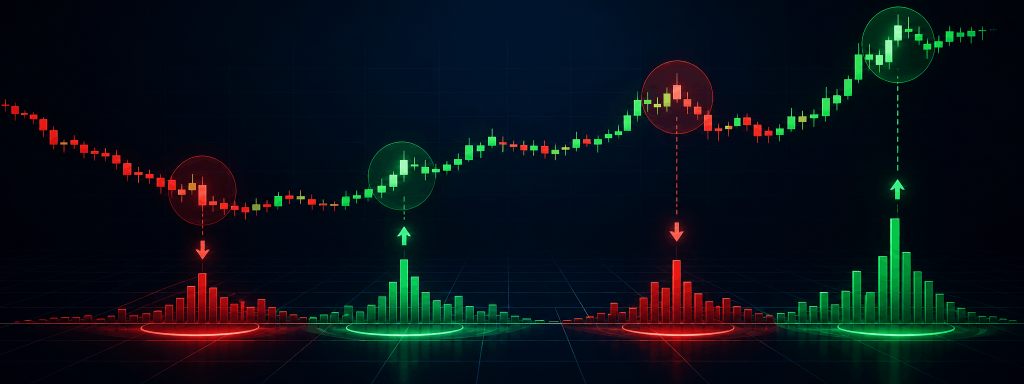
Volume becomes most useful when it’s analyzed alongside price action.
Think of price as showing where the market is moving, while volume reveals how much support there is behind that move. When both tell the same story, traders tend to have more confidence in the signal.
Price Rising on Strong Volume
When a stock moves higher and volume increases at the same time, it often points to genuine buying interest.
This is particularly encouraging when the stock is breaking above resistance, moving into a new trend, or continuing an existing uptrend. The higher volume suggests that more traders are willing to buy at higher prices, which can help support further gains.
Price Rising on Weak Volume
A price increase isn’t always a sign of strength.
If a stock rises while volume remains below average, it may indicate that the move isn’t attracting much participation. Without enough buyers supporting the advance, the rally can sometimes stall or reverse.
Price Falling on High Volume
When a stock declines on heavy volume, it often suggests sellers are becoming more aggressive.
This type of move can be a warning sign, especially if the stock breaks below an important support level or reacts negatively to earnings, economic news, or company-specific developments.
Price Falling on Low Volume
Not every decline is a reason to worry.
A pullback that occurs on light volume may simply reflect short-term profit-taking rather than a meaningful shift in sentiment. In a healthy uptrend, these quieter declines can sometimes create opportunities for traders looking to enter at a better price.
Bullish and Bearish Volume Signals
| Volume Pattern | What It Suggests | Trading Interpretation |
| Price rises on strong volume | Buyers are actively participating | Bullish confirmation |
| Price rises on weak volume | Limited buying interest | Proceed with caution |
| Price falls on strong volume | Sellers are in control | Bearish confirmation |
| Price falls on weak volume | Selling pressure is limited | Possible pullback |
| Breakout on high volume | Strong conviction behind the move | Potential entry signal |
| Breakout on low volume | Lack of market participation | Higher risk of failure |
| High volume with little price movement | Buyers and sellers are evenly matched | Watch for a breakout |
Using Volume to Confirm Breakouts

So breakouts. Everyone gets excited about them. Price cracks above resistance and traders think they found the next big move. Half the time it’s garbage.
Here’s the thing. A real breakout has weight behind it. Volume spikes. People actually buying. Price closes strong, nowhere near support. Then the next day? Still up. Still holding. That’s real.
Fake breakout? Volume’s dead. Price breaks above, you’re excited, then it just… falls back. Two days later you’re back where you started. Why? Nobody was actually buying. It was just a fluke bar.
What a Strong Breakout Actually Looks Like
When you see a real breakout, it has these things going for it. Not all of them every time, but most of them.
- Volume spikes on the breakout bar. Fat volume bar, not flat.
- Price closes strong, near the high of the day. Not middle of the range.
- Next day opens and holds above the breakout level. Doesn’t gap back down.
- Buying interest continues. More volume bars in the days after.
- Price doesn’t immediately retest that resistance level again. It just keeps going.
You see all five things? That breakout’s probably going to work. You see two of them? Be cautious. The setup’s weak.
How to Spot a Breakout About to Fail
Weak breakouts show themselves pretty quick. Once you know what to look for, you’ll start skipping them automatically.
- Volume on the breakout bar is flat. Below average. Nobody’s stepping in.
- Price breaks above resistance but momentum dies immediately. No follow-through.
- Buyers don’t show up. You get one bar above, then price starts drifting back.
- Price falls right back into the old range. Could be same day, could be next day.
- Volume evaporates right after the move. That spike doesn’t continue.
- See these things? Skip the trade. It’s going to fail. Don’t fight it.
The Volume Check You Should Do Every Time
When you see a breakout, don’t get excited. Check the volume. Is it fat? Or is it flat? That’s the whole decision.
- Fat volume on the breakout bar? Something might actually be happening. Keep watching.
- Flat volume on the breakout bar? It’s going to fail. Move on to the next one.
- Volume continuing after? Real move. Volume dying? Fake move.
Real breakouts have volume. That’s the filter. Everything else is just noise.
Using Volume to Spot False Breakouts
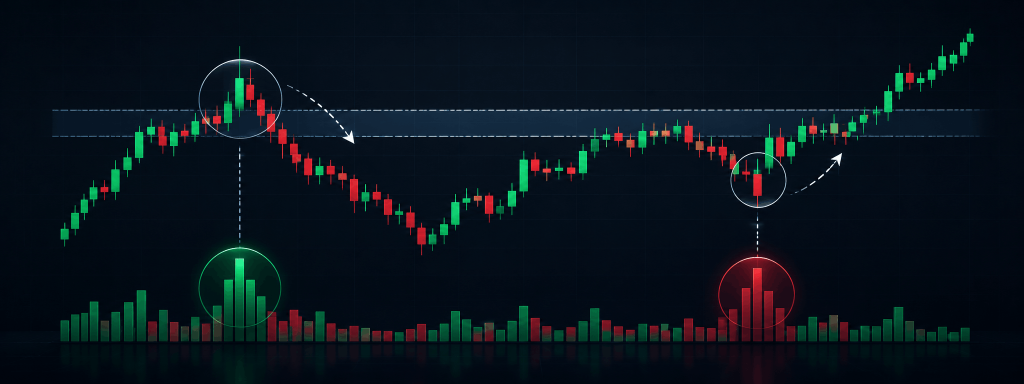
False breakouts are the worst. You see price crack above resistance. You get excited. You think you found the move. Then price just… dies. Falls back through. You’re holding the bag.
They happen constantly. More than real breakouts honestly. Why? Because one or two buyers step in, price moves above resistance, then nobody else shows up. It’s fake. The move had no foundation.
Volume tells you it’s fake before you lose money.
How Volume Reveals the Trap
Price breaks above resistance. Looks good on the chart. But check the volume bar. Is it fat or flat?
- Volume stays low on the breakout? That’s the red flag. Nobody’s actually buying.
- Price moved above resistance on basically no volume? The move’s not real. It’s going to reverse.
- You’re tempted to chase it? Don’t. Volume says it’s fake.
That’s the filter. Low volume breakout equals false breakout. High probability it fails.
The Confirmation Trick That Actually Works
So you see a breakout but volume’s weak. Don’t take it yet. Wait. See what happens next.
- Does price close above resistance at the end of the day? Check that.
- Next session opens. Is it above resistance still or did it gap back down? That tells you everything.
- If it holds for the next few sessions with volume staying elevated? Now it’s probably real.
- If price drops back through resistance within a day or two? It was false. You dodged it.
Most traders see a breakout and jump in immediately. The smart ones wait. They let the market prove it’s real. Volume shows you which is which.
The False Breakout That Kills Accounts
Worst scenario is you take the breakout on low volume, get stopped out, then price actually follows through and goes higher. That happens. You get shaken out at the worst time.
Better play? Don’t take the low volume breakout at all. Wait for one with real volume behind it. Yes, you’ll miss some winners. But you’ll miss way more losers. The math works out.
False breakouts exist because brokers and algorithms know where the stops are. They’ll push price above resistance, hit the stops, then reverse.
Volume tells you when that’s happening. Low volume = manipulation. High volume = real buyers. Pick the high volume ones.
Key Volume Indicators Traders Actually Use
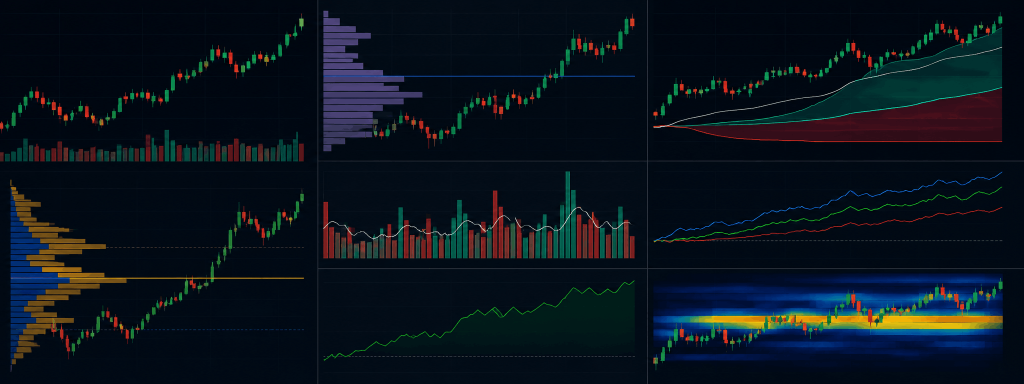
Raw volume works fine. But there’s tools that make it easier to read. Some traders swear by them. I’ll be honest they help but they’re not magic.
Relative Volume (RVOL)
This one’s simple. It compares what’s happening today to what normally happens. A stock trades a million shares a day usually. Today it’s four million. That’s 4x normal. Something’s happening.
Stock jumping on 2x normal volume? Okay, people are interested.
Stock jumping on 10x normal volume? Now you’re talking. Something real.
Stock quiet on 0.5x normal volume? Dead. Don’t trade it.
You see RVOL spike on earnings, major news, big breakouts, that kind of thing. It’s just a faster way to see “is this volume actually high or am I imagining it?” Beats staring at numbers.
On-Balance Volume (OBV)
OBV measures whether buyers or sellers are actually in control. Price goes up on the OBV going up? That’s aligned. Bullish. But here’s the trap—price goes up while OBV goes down? Sellers are winning underneath.
- Price up, OBV up. Real bull move. Stay in.
- Price up, OBV down. Buyers are getting tired. Exit soon.
- Price down, OBV down. Real bear move. Stay out.
- Price down, OBV up. Sellers are getting weak. Reversal might be coming.
This catches divergences. Price looks strong on the chart but OBV’s flat or falling? The strength is fake. Buyers are actually leaving. You see that before price falls and you get out early.
Volume Weighted Average Price (VWAP)
VWAP’s the average price weighted by how much volume happened at each level. Institutions use it as a benchmark. So now retail traders watch it too.
- Price above VWAP? Buyers are in control. Mostly.
- Price below VWAP? Sellers have the edge.
- Price bouncing off VWAP? That’s support or resistance. Could be a bounce setup.
On a four hour chart or daily, VWAP can act like dynamic support. Price dips to VWAP, bounces. Dips to VWAP, bounces. That’s a signal. But don’t treat it like gospel. It’s just another tool.
Which Indicator Actually Matters
Honest answer? Raw volume matters most. You see a fat volume bar, you know something happened. You don’t need an indicator for that.
OBV’s useful for catching divergences before they blow up on you. RVOL’s handy if you’re lazy about comparing to normal. VWAP’s good for support and resistance if you’re on longer timeframes.
But none of them replace actually looking at the chart. Don’t get lost in indicators. Price and volume. That’s 90% of what you need.
How to Use Volume in a Trading Strategy
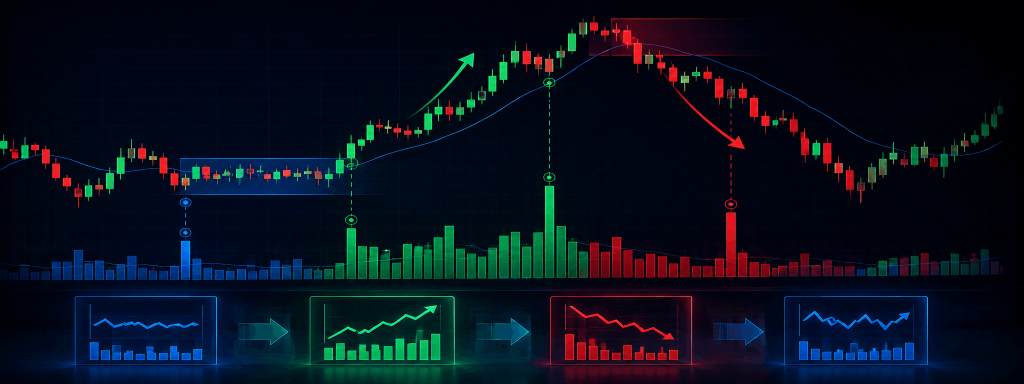
Volume’s a supporting tool. Not the main thing. If you try to trade volume alone, you’ll lose. But paired with price action? That’s where it matters.
Here’s how you actually use it without overthinking.
First: Know Which Direction The Market’s Moving
Before you even look at volume, know the trend. Is price going up, going down, or just sitting sideways?
- Uptrend? You’re looking for volume on the up moves and lighter volume on pullbacks.
- Downtrend? You want volume on the down moves, lighter on bounces.
- Sideways? Volume gets confusing. Skip it until price picks a direction.
Volume signals are way easier to read when you know the context. Don’t try to interpret volume in a vacuum.
Second: Find The Levels That Actually Matter
Support and resistance. Price bounces off them or breaks through them. That’s where volume gets interesting.
- Is price approaching a major resistance level? Watch what volume does when it gets there.
- Is it testing support? Volume tells you if the bounce is real or about to fail.
- Fat volume at a level? That’s institutional activity. Something’s happening.
Volume spikes at key levels because institutions accumulate or distribute there. That’s the whole game.
Third: Compare Today To Normal
Don’t judge volume in isolation. Judge it against what that stock normally does.
- Stock normally trades 2 million shares? Today it’s 6 million. That’s 3x normal. Pay attention.
- Stock usually moves with 20k volume bars? Today’s bar is 80k. Something changed.
- Average volume down 50% from normal? The stock’s dead. Don’t trade it.
Your broker’s charts usually show average volume. Use it. Don’t guess.
Fourth: Price Has To Confirm It
Volume can suggest something’s happening. But price has to actually do it.
Price breaks above resistance on fat volume? Okay, keep watching.
Price then closes near the high? Now you’re interested.
Next day it keeps going up? Real move. Take it.
Price breaks above on fat volume but then immediately falls back? False. Skip it.
Volume gets your attention. Price confirms it’s real. Don’t trade volume signals without price confirmation.
Fifth: Always Have A Stop
Even the best volume signals can fail. Markets surprise you. So you always have an exit plan.
- Set your stop loss before you enter. Not after.
- Put it below support if you’re long, above resistance if you’re short.
- Position size so that stop loss doesn’t hurt too much if it gets hit.
- Don’t move the stop closer to profits and then get stopped out. Respect your original plan.
Risk management isn’t sexy but it’s how you stay alive long enough to make money.
Common Mistakes When Using Stock Volume
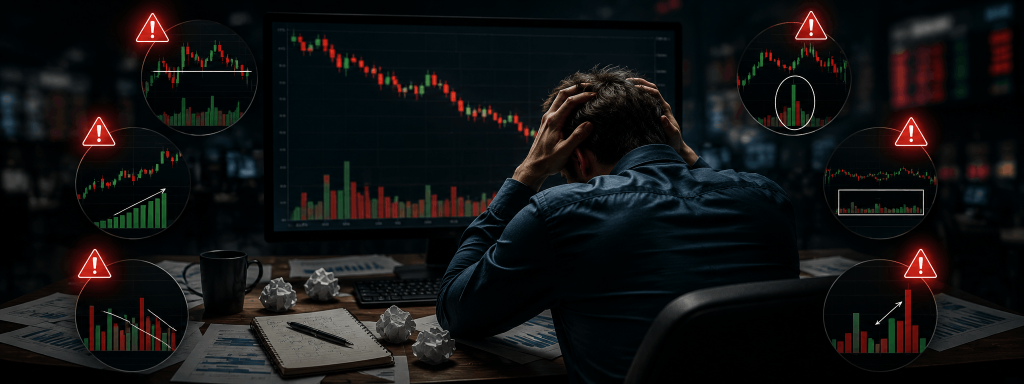
People mess up volume in pretty consistent ways. Same mistakes over and over. If you know what they are, you won’t be the person losing money to them.
Thinking Volume Is Enough By Itself
This is where most people fail. They see a volume spike and think that’s the signal. Buy it. Done.
- Volume spiked but price didn’t move. That’s noise, not a trade.
- Volume spiked but it was a dump, not a move up. Wrong direction.
- Volume spiked but support and resistance say price is going the wrong way. You lose.
Volume confirms what price is doing. It doesn’t replace what price is doing. If price action sucks, volume doesn’t save it. You need both. Price first, volume second.
Not Knowing What Normal Actually Is
A stock looks busy to you so you think volume’s high. Maybe it’s not. Maybe that’s just Tuesday for that stock.
- Stock X trades 50 million shares normally. Today it’s 60 million. That’s 1.2x. Not high.
- Stock Y trades 2 million shares normally. Today it’s 6 million. That’s 3x. Actually high.
- You don’t compare and you take both trades the same way. One loses, one might work. You can’t tell which is which.
Know what normal is for the stocks you trade. Average volume matters. More than the raw number.
Chasing Volume Spikes Too Late
Volume spikes and everyone notices at the same time. By then the move’s already half done. You buy. Price stalls. You lose.
- Big volume bar appears. Looks exciting. You jump in.
- Price continues higher but volume fades on the next bars.
- You’re up on paper but then price reverses and takes you out with a tiny loss.
- The move was 2% up. You caught 1% of it and got shaken out at breakeven. Happened a thousand times.
By the time volume spike is obvious, the smart money’s already in. You’re buying the end of the move. Wait for a pullback. Wait for price to find support. Then volume spike again. That’s when you enter, not on the first spike.
Missing What Actually Caused The Volume
Volume spiked. Why? If you don’t know, you’re guessing about what happens next.
- Earnings announcement? Volume might stick high and direction might be solid.
- Random algo dump? Volume spikes for two bars then nothing happens.
- Analyst upgrade? People buy, volume stays elevated, trend continues.
- Short squeeze rumor on Reddit? Volume explodes then crashes. People lose money chasing it.
Check the news. Check the calendar. If you don’t know why volume spiked, you don’t know if it means anything. Volume without context is just noise.
The Real Problem
Traders want volume to be a signal by itself. A magic button. It’s not. It’s a confirmation tool. Price does something. Volume confirms it’s real.
Everything I just listed? It’s traders ignoring that fact and trying to trade volume instead of price. That’s why they fail.
Use volume right and it saves you from fake breakouts and bad entries. Use it wrong and it costs you everything. The difference is respecting what it actually is.
Is High Volume Always Bullish?

No. That’s the whole trap people fall into.
- They see fat volume and think “bullish.” Buy.
- Then price crashes and they get destroyed wondering what happened.
- Volume isn’t bullish or bearish. Volume is just volume.
- What matters is what price is doing with that volume.
High Volume Going Up = Actual Buying
This is bullish. Price rising on fat volume means buyers actually showed up.
- Stock breaks above resistance on 3x normal volume. Buyers stepped in for real.
- Price closes strong near the high with that volume. Conviction. Bullish.
- Next day opens higher and the volume was real. Still bullish.
This is what you want to see. Price and volume aligned upward. Real move.
High Volume Going Down = Actual Selling
This is bearish. Price falling on fat volume means sellers are in control, not buyers.
- Stock breaks below support on 3x normal volume. Sellers are aggressive.
- Price closes near the low with that volume. Panic. Real selling.
- Next day opens lower. Volume dump was legit. Bearish.
People see high volume and assume up. Wrong. High volume down is just as real as high volume up. Maybe more real because it’s aggressive.
The Trap: High Volume But Wrong Direction
This is where people get confused. Stock’s been going up. Volume spikes. But price actually drops on that volume spike.
- You’re holding longs. Volume spike seems bullish. But price is falling.
- That volume spike is sellers, not buyers. You’re about to get stopped out.
- Volume just told you the trend reversed. You ignored it because you thought volume = up.
Volume tells you activity level. Price tells you which direction. You need both. Volume without price direction is useless. Price without volume is questionable.
Conclusion
Volume’s actually simple. It shows you if people care about what price is doing. That’s the whole thing.
You see a trend on the chart but volume’s tanking? That trend’s about to die. You see volume exploding into a level? Something’s happening. Real money’s moving.
Don’t just watch volume by itself though. Price matters. Support and resistance matter. Risk management matters. But volume? It’s the confirmation. It’s what tells you if what you’re looking at is actually real or just noise you’re about to lose money on.
Most traders skip this. They watch price and ignore volume. Then they take a trade that looks perfect and it gets destroyed because there was nobody behind it. Check the volume. Always.
You might also like:
The 9 Best Technical Indicators for the Stock Market
How to Use Stock Volume as a Trading Signal?
What is Cryptocurrency Staking?
How many shares actually moved. That’s it. You look at a price chart and you see it went up. But did anyone care? Volume tells you. If volume’s flat while price went up, nobody’s really buying. If volume’s fat while price went up, people actually showed up. Big difference.
Neither. It’s just information. High volume up? Could be buyers stepping in. High volume down? Could be sellers panicking. You have to look at price direction at the same time. Volume by itself tells you nothing.
No. Volume won’t tell you where price goes next. But it confirms what’s probably real and what’s probably fake. If price is breaking out on dead volume, it’s probably going to fail. That’s not prediction. That’s just filtering out the garbage.
Whatever’s above normal for that stock. If a stock normally trades 5 million shares a day, you want to see 10+ million on a breakout. If it normally trades 50 million, you want 100+. Compare to the average. That’s all that matters.
Yes. It’s literally the easiest thing to read. Fat bar or flat bar. That’s the whole analysis. You don’t need an indicator or formula. Just look at the chart and see if the bar is thick or thin. Thick on the move you want to take? Good. Thin? Skip it.
Because price is flashy and volume is boring. You see price breakout and you want to buy it immediately. You don’t have time to check volume. Then you get stopped out and wonder why. You didn’t check volume. That’s why. Most traders learn this the hard way.
Yes but differently. One minute volume is noise. Fifteen minute volume starts mattering. Four hour volume really matters. Daily volume is what institutions care about. The longer the timeframe, the more real the volume signal. Day traders should use hourly minimum. Swing traders use four hour or daily.
Taking every volume spike as a signal. Volume spikes constantly. Doesn’t mean anything without price confirmation. You see volume spike, you jump in, price goes the wrong way, you lose. The volume spike was probably algo activity or some random order. Not a real move. Wait for price to actually move, then check if volume backs it up.
Sometimes. Price going up but volume going down means the uptrend’s getting weak. Buyers are losing interest. Could be a reversal coming. But it’s not a guaranteed signal. You need other confirmation. It’s a warning, not a trade by itself.
Because they’re moving huge money. They need liquidity. They can’t just market order a million shares and expect to get it without moving price. They look at volume to see where they can accumulate or distribute without moving price too much. That’s why volume spikes at key levels. Institutions are doing business there.
 ABOUT THE AUTHOR
See More
ABOUT THE AUTHOR
See More