Crypto Strategy: Parabolic SAR Trading Strategy

The Parabolic SAR is a trend-following indicator crypto traders use to identify market direction, spot possible reversals, and manage trailing stop-losses. It appears as a series of dots above or below price. When the dots are below price, the market is usually in an uptrend. When the dots are above price, the market is usually in a downtrend.
Important: This article is for educational purposes only and does not guarantee trading profits. Crypto markets are volatile, and technical indicators can produce losing signals.
What is Parabolic SAR indicator?
Parabolic SAR stands for Parabolic Stop and Reverse. It was developed by J. Welles Wilder Jr., who also created other well-known technical indicators such as RSI and ADX.
How do traders use Parabolic SAR in crypto?
Crypto traders use Parabolic SAR in three main ways:
- Trend direction: dots below price suggest bullish momentum, while dots above price suggest bearish momentum.
- Entry and exit timing: a dot flip from above to below price may suggest a potential long signal, while a flip from below to above price may suggest a potential exit or short signal.
- Trailing stop-loss placement: traders may use the latest SAR dot as a dynamic stop reference as the trend develops.
Parabolic SAR Trading Strategy overview
- How Parabolic SAR works on a crypto chart
- Calculating the SAR Indicator
- How Is The Parabolic SAR Used In Crypto?
- Parabolic SAR buy and sell signals
- Things To Watch Out For When Trading Crypto With The Parabolic SAR
- Predicting Prices And Trend Direction With The Parabolic SAR
- Combining Parabolic SAR with Other Indicators
- Common Mistakes To Avoid When Using The Parabolic SAR Indicator
- Conclusion
How Parabolic SAR works on a crypto chart
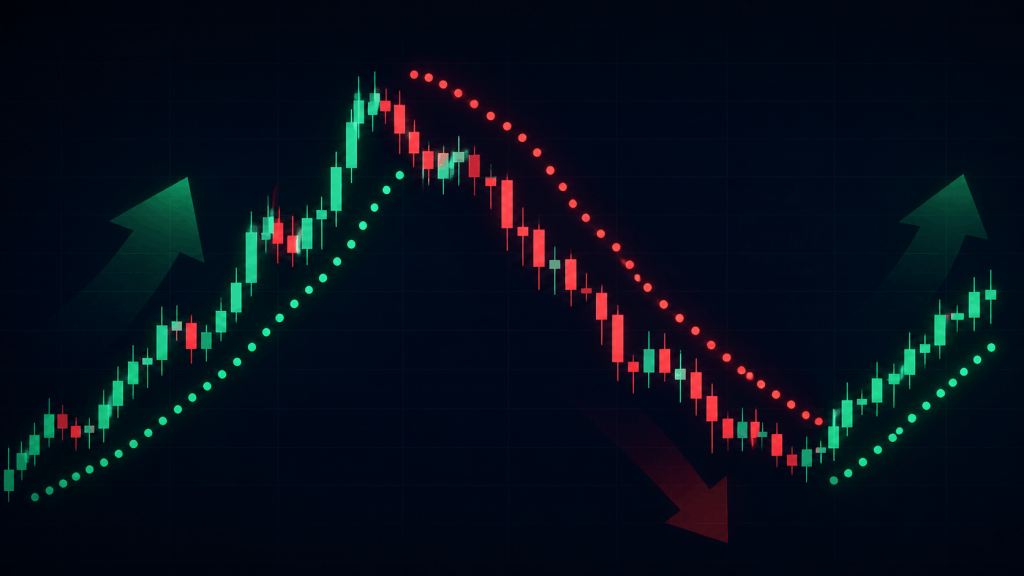
On a crypto chart, Parabolic SAR follows price as the trend develops.
In an uptrend, the dots appear below price and usually rise as price moves higher. This can help traders trail a stop-loss upward. In a downtrend, the dots appear above price and usually move lower as price falls.
The key moment is the dot flip.
A dot flip happens when the SAR changes sides:
from above price to below price, suggesting a possible bullish reversal
from below price to above price, suggesting a possible bearish reversal
However, traders should be careful. A dot flip does not always mean a strong reversal is starting. In crypto, sudden wicks, low-volume moves, weekend liquidity, and sideways consolidation can all create false flips.
Calculating the SAR Indicator
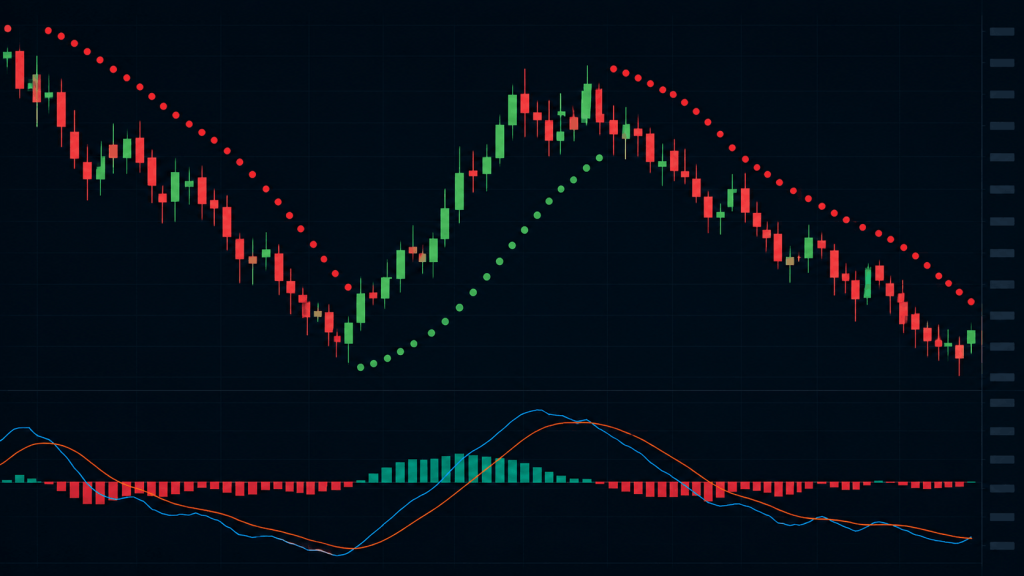
The Parabolic SAR indicator is calculated using a specific formula that incorporates key parameters to track the trend. The formula is as follows:
| Formula element | Meaning | How it is used |
| SARₙ | Current Parabolic SAR value | The new SAR level plotted on the current candle. |
| SARₙ₋₁ | Previous Parabolic SAR value | The prior SAR level used as the starting point for the next calculation. |
| AF | Acceleration Factor | Controls how quickly the SAR moves toward price as the trend continues. |
| EPₙ₋₁ | Previous Extreme Point | The highest high in an uptrend or the lowest low in a downtrend. |
| AF × (EPₙ₋₁ − SARₙ₋₁) | Adjustment amount | Measures how much the SAR should move toward the extreme point. |
| SARₙ = SARₙ₋₁ + AF × (EPₙ₋₁ − SARₙ₋₁) | Full Parabolic SAR formula | Calculates the current SAR value based on the previous SAR, acceleration factor, and prior extreme point. |
The acceleration factor (AF) is a crucial parameter that controls the movement of the SAR dots. It starts at a default value, typically 0.02, and increases as the trend strengthens, causing the SAR dots to move closer to the price at an accelerating pace. This helps the indicator adapt to the trend’s momentum.
The maximum acceleration (MA) parameter limits the growth of the AF, preventing it from becoming too sensitive and generating false signals.
How Is The Parabolic SAR Used In Crypto?

As you can see from the chart above, using parabolic SAR in crypto trading is simple. In an uptrend, the dots are below price and moving upward; in a downtrend, the opposite is true.
Given its intuitive presentation, the PSAR is ideal for trend and reversal trading. The PSAR signals that one of three actions is possible at any given time:
- Buy: If the dots are beneath price, a buy is suggested. Also, the greater the upward slope of the dots, the stronger the bullish trend.
- Sell: If the dots are above price, a sell is suggested. In addition, the greater the downward slope of the dots, the stronger the bearish trend.
- Neutral: During consolidation patterns or sideways action, the PSAR will still print dots above or below price action. However, they will have a flat trajectory and are less reliable. When in rotational cryptocurrency market conditions, it is best to wait until the market breaks out and chooses a direction before entering a trade.
The key element of trading cryptocurrencies with the PSAR is recognizing when the dots cross over price. When this happens, it is considered to be a sign of reversal and a potential buy or sell signal.
For example, check out the daily Bitcoin chart below.
As you can see, a formidable daily downtrend begins at April’s spike high near $65,000. At this point, the dots jumped above price, signaling that it was time to sell. The opposite scenario was true when BTC posted its April low near $46,000.
Parabolic SAR buy and sell signals
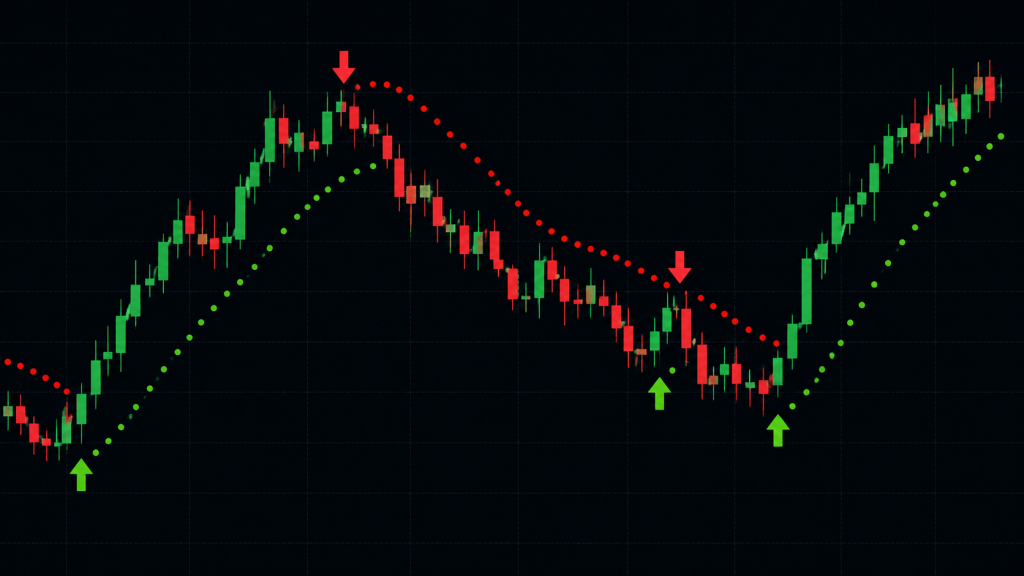
Bullish signal: dots flip below price
A bullish Parabolic SAR signal happens when the dots move from above the candles to below the candles.
This suggests that bearish pressure may be weakening and bullish momentum may be starting.
A trader might consider this a potential long signal when:
- price is above a key moving average
- the broader market trend is bullish
- RSI or another momentum indicator confirms strength
- the signal appears after a candle closes, not while the candle is still forming
- the setup does not appear directly below major resistance
Bearish signal: dots flip above price
A bearish Parabolic SAR signal happens when the dots move from below the candles to above the candles.
This suggests that bullish momentum may be weakening and bearish pressure may be starting.
A trader might consider this a potential exit or short signal when:
- price is below a key moving average
- the broader market trend is bearish
- momentum is weakening
- the signal appears after candle close
- the setup does not appear directly above major support
- Exit signal: price crosses the SAR dots
Many traders use Parabolic SAR as an exit tool rather than a pure entry tool.
For example, if a trader is long Bitcoin and the SAR dots are below price, they may stay in the trade while price remains above the dots. If price closes below the SAR dots and the dots flip above price, the trader may exit or reduce the position.
This approach can help protect profit during trends, but it can also produce early exits during normal pullbacks.
Things To Watch Out For When Trading Crypto With The Parabolic SAR
Like using the parabolic SAR in forex trading, there are a few things to watch out for in crypto. Here’s a brief look at three of the most important:
False Signals:
- The Parabolic SAR (PSAR) can generate misleading signals, especially during periods of market consolidation or sideways movement.
- In choppy markets, PSAR dots frequently cross over price, leading to unreliable buy and sell signals.
- Reducing False Signals: Wait for multiple dots to confirm a trend or combine PSAR with another technical tool to strengthen reversal signals.
Market Fundamentals:
- PSAR is trend-based, so ignoring market fundamentals can lead to unexpected outcomes during live trades.
- Sudden news, regulatory changes, or security issues can disrupt PSAR’s accuracy due to rapid price swings.
- Best Practice: Monitor evolving fundamentals to align PSAR signals with broader market events, reducing the likelihood of losses from sudden volatility.
Risk vs. Reward:
- PSAR is suited for capturing larger profit targets typical of trend-based strategies, often aiming for a risk-to-reward ratio of 1:3 or higher.
- Managing Risk in Real-Time: Use PSAR as an exit signal to lock in gains dynamically, which helps maintain a balanced approach to risk and reward during active trends.
By following these practices, traders can use PSAR more effectively, minimizing false signals, aligning with market fundamentals, and managing risk for more consistent results.
Predicting Prices And Trend Direction With The Parabolic SAR
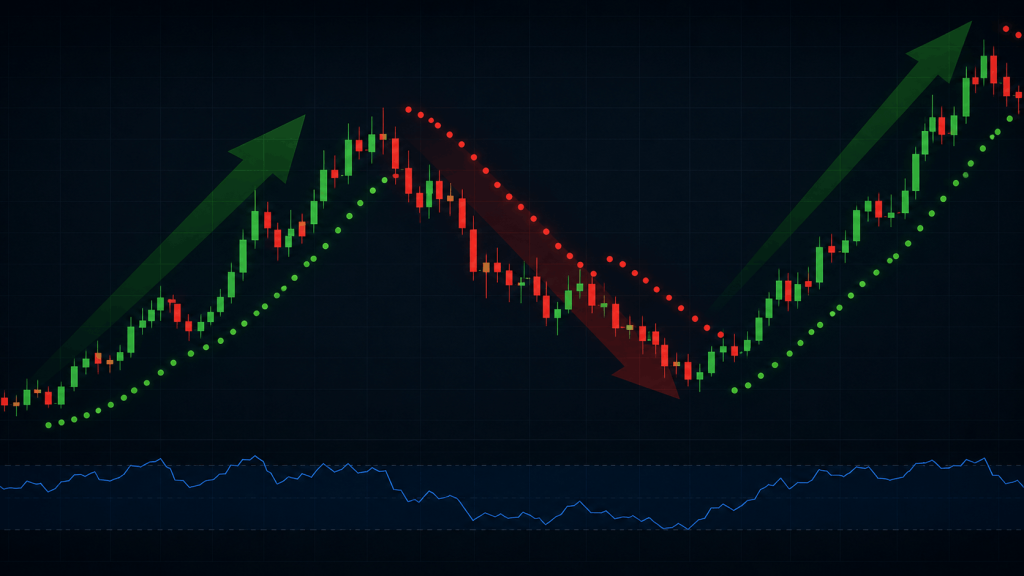
Crypto price prediction is always a delicate endeavor, specifically during periods of high volatility. When using the PSAR to attempt this task, it’s a good idea to view the market in broad terms. Remember, it is a lagging, trend-oriented indicator; this means that the data (dots) is reflective of what has happened, not what will happen.
Specific price points are hard to come by, but the dot crossovers are key. When the PSAR crosses over current price, it is safe to say that the market is under reversal.
If this is the case, then short-term price action is likely to follow suit. Of course, accurately estimating how long price will move directionally depends upon a myriad of other technical and fundamental factors.
Combining Parabolic SAR with Other Indicators
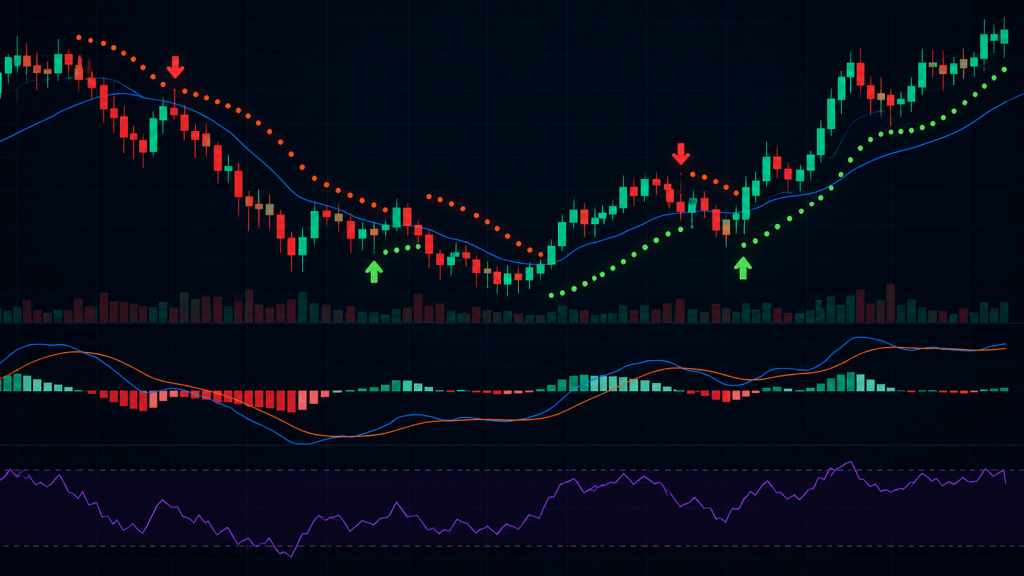
Enhance Parabolic SAR’s effectiveness by pairing it with additional indicators:
- Moving Averages: A Parabolic SAR buy signal combined with a golden cross confirms a strong uptrend, increasing confidence in long positions.
- RSI: Use Parabolic SAR with RSI to spot overbought/oversold conditions, validating potential trend reversals.
- Stochastic Oscillator: Combining with the stochastic oscillator highlights momentum shifts, helping avoid weak trends.
This multi-indicator approach filters out false signals, improves trend accuracy, and supports informed trading decisions.
Pros And Cons
Common Mistakes To Avoid When Using The Parabolic SAR Indicator
No matter how strong a crypto indicator or trading signal is, it’s still possible to make mistakes. Here are are several of the most common made when trading the PSAR:
- Overleveraging: No indicator is infallible! Be sure to practice sound risk management and avoid using too much leverage.
- Premature Market Entry: In many cases, traders are anxious to enter the market and do not wait for PSAR confirmation. To be successful using this indicator, it’s a good idea to wait for more than one dot before entering a new trend.
Apply To Sideways Markets: The PSAR is not a rotational or breakout indicator. If you’re going to use it to trade cryptos, wait for periods of enhanced volatility or clear-cut trends.
Conclusion
The parabolic SAR is a great trend and reversal trading tool. It’s easy to read, understand, and produces clear-cut signals. When applied within the context of a comprehensive cryptocurrency market plan, the PSAR can be an invaluable tool for active traders.
If you’re interested in trading cryptos using technical analysis, the PSAR is a fantastic place to start.
Frequently Asked Questions
What is the Parabolic SAR in crypto trading?
The Parabolic SAR (Stop and Reverse) is a trend-following indicator that helps traders identify the direction of price movement and potential reversal points. Created by Welles Wilder Jr., it’s widely used in crypto trading to spot buy and sell signals.
How does the Parabolic SAR indicate buy and sell signals?
When the Parabolic SAR dots are below the price, it signals an uptrend, suggesting a buying opportunity. When the dots are above the price, it indicates a downtrend, signaling a possible sell. Crossovers between price and SAR dots often suggest a trend reversal.
Can the Parabolic SAR be used in all market conditions?
The Parabolic SAR is most effective in trending markets. In sideways or consolidating markets, it can produce false signals due to frequent crossovers, so traders often avoid using it in such conditions.
How is the Parabolic SAR calculated?
The Parabolic SAR calculation involves two key factors: the Extreme Point (EP) of the trend (high or low) and the Acceleration Factor (AF). The formula adjusts with each new price movement to track the trend. Fortunately, most trading platforms calculate and plot the SAR automatically.
What are the advantages of using the Parabolic SAR in crypto trading?
The Parabolic SAR provides easy-to-read visual cues for trend reversals, making it user-friendly. It’s also highly versatile, applicable to any cryptocurrency and timeframe, and works well in combination with other indicators like RSI or moving averages.
What are some limitations of the Parabolic SAR?
As a lagging indicator, the Parabolic SAR can sometimes signal a trend change late, especially during rapid price shifts. It’s also less reliable in choppy or consolidating markets, where it may produce numerous false signals.
What mistakes should traders avoid when using the Parabolic SAR?
Common mistakes include over-leveraging, entering trades prematurely without multiple confirmations, and using the Parabolic SAR in sideways markets where it tends to be less accurate. Waiting for multiple dots to confirm a trend is often recommended.
How can the Parabolic SAR be combined with other indicators?
Traders often pair the Parabolic SAR with indicators like the RSI for added confirmation of overbought or oversold conditions, or with moving averages to verify trend direction. This helps filter out false signals and provides a clearer trading strategy.
How does the Parabolic SAR fit into a risk management strategy?
The Parabolic SAR can help set stop-loss levels as it tracks trend direction. By adjusting stops with each SAR dot, traders can secure profits and manage risk effectively, especially during strong trends.
Is the Parabolic SAR useful for predicting future crypto prices?
While not predictive, the Parabolic SAR provides valuable trend and reversal signals, helping traders gauge likely price direction. For price predictions, traders typically combine the Parabolic SAR with other technical and fundamental analyses.
 ABOUT THE AUTHOR
See More
ABOUT THE AUTHOR
See More


Sidebar rates

