Automated vs Manual Crypto Signals

Crypto trading signals are tools that help traders identify potential opportunities in the cryptocurrency market. A signal usually contains key information such as the asset to trade, a suggested entry price, stop-loss levels, and profit targets. These signals can guide traders on when to buy or sell a cryptocurrency and how to manage risk.
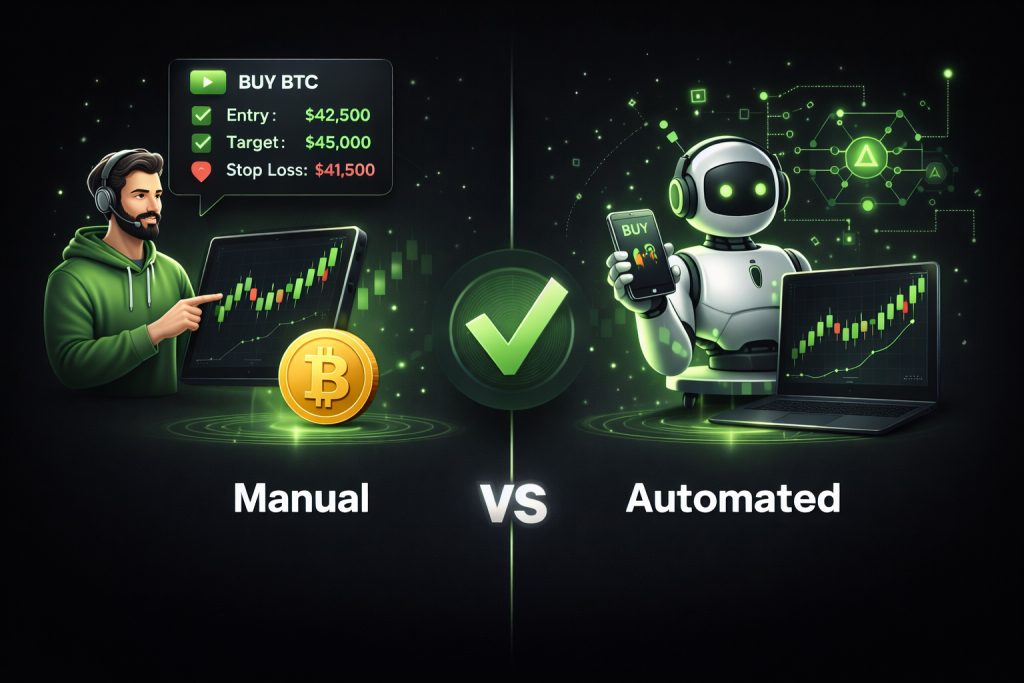
Signals are generally generated in two different ways: by human analysts or by automated systems. As a result, crypto trading signals are commonly divided into two categories: manual crypto signals and automated crypto signals. Understanding how each type works can help traders choose the approach that best suits their trading style and level of experience.

 | Minimum Deposit: $100 Regulated by: CBI, BVI, FSC, ASIC, FSCA, JFSA, FFAJ Crypto: Yes |
What Are Crypto Trading Signals?
Crypto trading signals are trade suggestions based on market analysis. They are designed to help traders identify potential price movements and make more informed trading decisions.
Signals are usually generated using technical indicators, chart patterns, market sentiment, or fundamental factors such as economic events and industry news. Some signals are sent to traders through messaging groups, trading platforms, or mobile apps, while others are executed automatically through trading bots or automated systems.
 | Minimum Deposit: $50 Regulated by: AUSTRAC, BAFIN, CIMA, ESCA, CySEC, FSC, FMA, MAS, TFG, VFSC Crypto: Yes |
What Are Manual Crypto Signals?
Experienced traders or analysts create manual crypto signals by studying the market and sharing their trading ideas. They base these signals on detailed market analysis, including chart patterns, technical indicators, and broader market developments.
In many cases, analysts evaluate price action, support and resistance levels, and overall market trends before issuing a signal. The trader who receives the signal then decides whether to place the trade manually.
Advantages of Manual Crypto Signals
Manual signals offer several benefits, particularly for traders who want insights from experienced market participants.
Human insight and interpretation
Experienced traders can interpret complex market behavior and consider multiple factors that may not always be captured by automated systems.
Flexibility during market changes
Human analysts can quickly adapt to sudden market developments such as breaking news, regulatory announcements, or shifts in market sentiment.
Educational value
Many signal providers explain the reasoning behind their trades, which can help beginner traders understand strategies and improve their own analytical skills.
Variety of strategies
Different analysts may use different trading approaches, which can expose traders to a wider range of strategies and perspectives.
Disadvantages of Manual Crypto Signals
Despite their advantages, manual signals also have several limitations.
Emotional influence
Human traders may sometimes be affected by emotions such as fear or overconfidence, which can impact decision-making.
Slower execution
Manual signals require traders to enter trades themselves, which can delay execution and potentially affect the final entry price.
Limited monitoring time
Since the cryptocurrency market operates around the clock, it can be difficult for human analysts to monitor opportunities continuously.
Reliance on the analyst
The accuracy and reliability of manual signals depend heavily on the knowledge and experience of the person providing them.

 | Minimum Deposit: $25 Regulated by: FSC, MISA Crypto: Yes |
What Are Automated Crypto Signals?
Automated crypto signals are generated by algorithms, trading bots, or artificial intelligence systems. These systems analyze large amounts of market data and generate signals based on predefined rules or trading strategies.
Automated tools can track price movements, identify patterns, and produce signals within seconds. In some cases, they can even execute trades automatically without requiring direct human involvement.
Advantages of Automated Crypto Signals
Automated signals offer several advantages for traders who prefer speed and efficiency.
Continuous market monitoring
Automated systems can monitor cryptocurrency markets 24 hours a day, identifying opportunities across multiple trading pairs simultaneously.
Emotion-free trading decisions
Because automated signals follow programmed rules, they remove emotional decision-making from the trading process.
Fast trade execution
Algorithms can detect trading opportunities and execute signals almost instantly, which can be useful in fast-moving markets.
Ability to analyze large datasets
Automated systems can process large volumes of market data much faster than a human trader, allowing them to identify patterns across many assets at once.
Disadvantages of Automated Crypto Signals
Although automated signals offer efficiency and speed, they also have certain drawbacks.
Limited ability to interpret market context
Automated systems may struggle to account for unexpected events or sudden shifts in market sentiment that are not part of their programmed strategy.
Dependence on historical data
Many automated systems rely on strategies that are based on past market performance, which may not always reflect future market conditions.
Technical complexity
Setting up and maintaining automated trading systems often requires technical knowledge and regular monitoring.
Risk of system errors
Software issues, poor algorithm design, or outdated strategies can sometimes result in inaccurate signals or unwanted trades.
 | Minimum Deposit: $200 Regulated by: ASIC, BaFin, CMA, CySEC, DFSA, FCA, SCB Crypto: Yes |
Automated vs Manual Crypto Signals – Key Differences
| Feature | Automated Signals | Manual Signals |
| Signal generation | Algorithms bots, or AI systems | Human traders or analysts |
| Execution speed | Very fast and often automatic | Slower, requires manual trade placement |
| Market coverage | Can monitor many cryptocurrencies at once | Usually limited to fewer markets |
| Emotional influence | No emotional bias | Possible emotional impact |
| Adaptability | Limited to programmed rules | Can adapt quickly to new information |
 | Minimum Deposit: $4 Regulated by: CySEC, ASIC, FSA, SVG Crypto: Yes |
Which Type of Crypto Signal Is Better?
Neither automated nor manual signals are universally better. The right option depends on a trader’s goals, experience level, and preferred trading style.
Automated signals may appeal to traders who want a more hands-off approach, faster execution, and constant market monitoring. Manual signals may be better suited to traders who value expert insights and want to understand the reasoning behind each trade.
Some traders choose to combine both methods. For example, automated systems can be used to identify potential opportunities, while human analysis is used to confirm whether a trade is worth taking.
| Minimum Deposit: $200 Regulated by: ASIC, BaFin, CMA, CySEC, DFSA, FCA, SCB Crypto: Yes |
In Conclusion
Both automated and manual crypto signals play an important role in modern cryptocurrency trading. Automated systems offer speed, efficiency, and continuous market monitoring, while manual signals provide human insight and strategic flexibility.
By understanding the strengths and limitations of each approach, traders can decide which method aligns best with their trading strategy. In many cases, combining automated tools with human analysis can create a more balanced and effective trading approach in the dynamic cryptocurrency market.
You might also like:
- AvaTrade Review
- MultiBank Group Review
- Elev8 Review
- Pepperstone Review
- FISG Review
- XM Review
- HFM Review
- PU Prime Review
- IUX Review
- FBS Review
Frequently Asked Questions
What are crypto trading signals?
Crypto trading signals are trade suggestions that indicate when to buy or sell a cryptocurrency, usually including entry price, stop-loss, and take-profit levels.
What are automated crypto signals?
Automated crypto signals are generated by algorithms or trading bots that analyze market data and produce trade recommendations automatically.
What are manual crypto signals?
Manual crypto signals are created by human traders or analysts who study the market and share their trading ideas.
Are automated crypto signals better than manual signals?
Not necessarily. Automated signals offer speed and consistency, while manual signals provide human insight and flexibility.
Do automated signals execute trades automatically?
Some automated systems only generate signals, while others can connect to trading platforms and execute trades automatically.
Are manual crypto signals suitable for beginners?
Yes, many manual signal providers explain their analysis, which can help beginners learn how trading strategies work.
Can automated signals trade 24/7?
Yes. Automated systems can monitor and analyze the crypto market continuously without needing breaks.
What is the main risk of automated crypto signals?
The main risk is relying on algorithms that may not adapt well to sudden market changes or unexpected events.
What is the main risk of manual crypto signals?
Manual signals depend on the skill and judgment of the analyst and may be affected by emotional decision-making.
Can traders use both automated and manual signals together?
Yes. Many traders combine automated tools for market scanning with manual analysis to confirm trading opportunities.
Faq
Crypto trading signals are trade suggestions that indicate when to buy or sell a cryptocurrency, usually including entry price, stop-loss, and take-profit levels.
Automated crypto signals are generated by algorithms or trading bots that analyze market data and produce trade recommendations automatically.
Manual crypto signals are created by human traders or analysts who study the market and share their trading ideas.
Not necessarily. Automated signals offer speed and consistency, while manual signals provide human insight and flexibility.
Some automated systems only generate signals, while others can connect to trading platforms and execute trades automatically.
Yes, many manual signal providers explain their analysis, which can help beginners learn how trading strategies work.
Yes. Automated systems can monitor and analyze the crypto market continuously without needing breaks.
The main risk is relying on algorithms that may not adapt well to sudden market changes or unexpected events.
Manual signals depend on the skill and judgment of the analyst and may be affected by emotional decision-making.
Yes. Many traders combine automated tools for market scanning with manual analysis to confirm trading opportunities.
 ABOUT THE AUTHOR
See More
ABOUT THE AUTHOR
See More


Sidebar rates


