Oracle’s AI Bubble Bursts: Peak Glory at $345, Now a $217 Hangover

ORCL ended the week at $217.58, up 1.52 percent, but it still had a 37 percent hangover from its 52-week high of $345.72. This is a microcosm of growing concerns about debt loads, AI infrastructure spending, and whether the “infinite demand” narrative for AI compute can withstand real-world economics.

Oracle’s Stock Surge Highlights Investor Confidence in Cloud Strategy

AI Hype Causes a 36 percent Single-Day Surge. Oracle’s best day since 1992 occurred in September 2025, when shares surged 36 percent in a single session, increasing the company’s market value by an astounding $244 billion and moving it closer to a $1 trillion cap. Blowout cloud demand figures and announcements of multi-billion-dollar AI contracts, such as an eye-catching $300 billion, five-year infrastructure agreement with OpenAI to construct enormous data centers for training and inference, were the catalyst.

Oracle’s recent decline in stock value reflects broader market concerns regarding the high valuations of AI-related companies, as its forward price-to-earnings (P/E) ratio exceeds 33. The company projects revenues of $166 billion from cloud infrastructure and $20 billion. Investors adopted a “sell the news” mentality, raising questions about the sustainability of these forecasts.

Oracle’s fundamentals remain solid. The company experienced  52% growth in cloud infrastructure and has $455 billion in remaining performance obligations (RPO), largely due to its partnership with OpenAI. Currently, the stock is trading at 13.9 times projected earnings for the end of this decade, leading some investors to view the decline as a potential buying opportunity.

Analysts predict an average stock price of $253 for November 2025, with a possible low of $212 if enthusiasm for AI diminishes. The stock’s price-to-free cash flow (P/FCF) ratio of 15.44 suggests it may be undervalued compared to historical averages. Overall, the recent drop indicates that investors are reassessing the profit growth expectations to justify current valuations.

Oracle has significantly benefited from the surge in AI infrastructure. The company recently announced a five-year deal worth over $300 billion with OpenAI for access to AI chips. After reporting $455 billion in remaining performance obligations—a 359% increase from the previous year—Oracle’s stock enjoyed its best day since 1992 following its September earnings report.

Additionally, Oracle confirmed a cloud agreement with Meta and disclosed a commitment of $65 billion in cloud infrastructure during the current quarter.

SpaceX Insider Sale Could Value Rocket Giant at $800 Billion

SpaceX is preparing to sell insider shares in a deal that could value Elon Musk’s rocket and satellite manufacturer at up to $800 billion, reinstating its position as the most valuable private company in the world.


The details that SpaceX’s board of directors discussed on Thursday at its Starbase hub in Texas could change depending on interest from insider sellers and buyers or other factors.

SpaceX is also considering a potential IPO as early as late next year. The price under discussion for selling some employees’ and investors’ shares is more than $400 per share, according to another person familiar with the situation. This would put SpaceX’s valuation between $750 billion and $800 billion.

Although a successful offering at these levels would break records, the company would not raise any money through this planned sale.

In a post on his social media platform X, Musk stated, “SpaceX has been cash flow positive for many years and does periodic stock buybacks twice a year to provide liquidity for employees and investors.” When the company raised funds and sold shares at a valuation of $400 billion, the share price under discussion would be a significant increase compared to the $212 per share set in July.

EchoStar Corp.’s stock rose after learning of SpaceX’s valuation,  18% for a satellite TV and wireless company. In addition to an earlier deal to sell roughly $17 billion in wireless spectrum to Musk’s business, EchoStar agreed last month to sell spectrum licenses to SpaceX for $2.6 billion

Breakup Bonanza: Netflix’s $5.8 Billion Warner Penalty Tops M&A History

Netflix acquired Warner Bros. for $72 billion. One of the largest breakup fees ever included in a deal is a $5.8 billion penalty that Netflix has agreed to pay if the deal collapses or isn’t approved by regulators.

Blue Chips Shine, Tech Stumbles: Netflix Miss Weighs on Wall Street

The fee, which is 8% of the deal’s equity value, is much higher than the typical amount even in large transactions, showing Netflix executives’ confidence in their ability to persuade international antitrust authorities.

According to a Houlihan Lokey report, the average breakup fee in 2024 was 2.4 per cent of the total transaction value.
Netflix’s multibillion-dollar commitment highlights the intense competition to take over the famous Hollywood studio.

Earlier this week, rival Paramount Skydance Corp. made a more substantial offer, increasing its proposed breakup fee to $5 billion—more than doubling it. Meanwhile, if Warner Bros. shareholders reject the deal, the company would have to pay a $2.8 billion reverse breakup fee. If Warner Bros. accepts a competing offer, the new buyer would be responsible for that cost.

XRP’s BlackRock Moment: The Silent Takeover That Changes Crypto Wealth

Maxwell Stein, the Director of Digital Assets at BlackRock, caused a stir in the crypto market.

“Trillions of dollars are poised to enter the blockchain ecosystem, but in the short term, we need to demonstrate the technology’s utility,” stated Maxwell Stein. Meanwhile, Adena Friedman, President and CEO of NASDAQ, elaborated on how banks have begun tokenizing bonds, fixed income assets, and stablecoins, particularly Central Bank Digital Currencies (CBDCs).

Ripple’s annual Swell conference is one of the most anticipated events in the cryptocurrency community. However, renowned analyst Digital Asset Investor recently noted that while the Swell conference may not directly impact prices, an announcement regarding an XRP exchange-traded fund (ETF) backed by BlackRock could have a significantly different effect. This comment reignited discussions about the factors that truly influence XRP’s market fluctuations and whether Swell WAS a meaningful price catalyst.

The consensus among digital asset investors is clear: the Swell conference typically does not lead to immediate changes in XRP’s value. The conference mainly focuses on cross-border payment innovations, blockchain integration, and industry collaboration—topics that support long-term fundamentals but rarely trigger short-term price spikes. Conversely, the analyst suggested that a formal XRP ETF, especially one backed by a major international investment firm like BlackRock, would dramatically transform the market landscape. Such an event would signify institutional support and regulatory recognition, potentially attracting significant capital inflows and influencing the token’s price.

Reactions on X varied among users. While some see potential, one user noted that the current market trend indicates weakness and consolidation, suggesting that broader declines may overshadow any positive developments. They also mentioned that retail traders might react emotionally in the short term.

The overarching conclusion is that traders differentiate between significant financial advancements and mere symbolic events. Although Swell’s global reach and institutional partnerships are noteworthy, they rarely generate headlines that impact the market. In contrast, the possibility of a BlackRock XRP ETF would have much larger implications for investor accessibility, liquidity, and long-term valuation.

Market participants will likely continue to look for signs of progress in institutional integration as Ripple’s Swell 2025 conference in New York approaches. However, until an ETF or regulatory milestone is officially announced, expectations for substantial price movements remain low.

Analysts Raise Micron Price Target, MU Stock Rebounds but Faces Resistance

Micron’s sharp swings this week captured the widening tension between optimism surrounding AI demand and rising market anxiety over sustainability, execution risks, and tightening industry conditions. Continue reading “Analysts Raise Micron Price Target, MU Stock Rebounds but Faces Resistance”

Intel Stock INTC Rebounds Right Back As Expected on Fundamental Catalysts

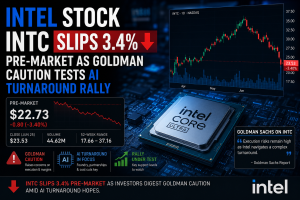
Intel’s rapid swing from a steep pullback to a sharp rebound has thrust the chipmaker back into market focus, stirring debate over whether its latest momentum reflects a durable turnaround or another fleeting upswing. Continue reading “Intel Stock INTC Rebounds Right Back As Expected on Fundamental Catalysts”

Forex Signals December 5: US PCE Inflation, Victoria’s Secret, Man U Earnings Preview

Markets brace for a pivotal blend of macro indicators and corporate updates as investors await U.S. PCE inflation data along with earnings results from Manchester United and Victoria’s Secret.
Continue reading “Forex Signals December 5: US PCE Inflation, Victoria’s Secret, Man U Earnings Preview”

Hewlett-Packard: HPE Tumbles on Gloomy Sales Forecast Amid AI Server Delays

Hewlett-Packard Enterprise shares fell after the company’s sales forecast for the current quarter did not meet high expectations for its AI server business.

According to a statement released by HPE on Thursday, the company’s revenue for the period ending in January is projected to be between $9 billion and $9.4 billion, with profits, excluding certain items, expected to range from 57 to 61 cents per share. Analysts surveyed by Bloomberg had predicted sales of $9.88 billion and an average profit of 53 cents per share.

The decline in sales for the fourth quarter of the fiscal year, which ended in October, was attributed to Chief Executive Officer Antonio Neri, who noted in an interview that their results also fell short of analysts’ projections. He explained that several agreements for servers designed to support AI workloads were postponed until 2026.

Specifically, some agreements with the U.S. government were delayed because of the federal government shutdown, and one transaction in Europe has been held up due to issues with a data center that is not yet ready.

Chief Financial Officer Marie Myers mentioned during a conference call with analysts that HPE is experiencing “substantial interest” in its AI servers, particularly from government and business clients. She noted, “We anticipate that demand will continue to be uneven because some of our largest sovereign clients are placing orders with long lead times, which may delay shipments to later dates.”

The Texas-based company is making a significant investment in networking as a key driver of future growth following the acquisition of Juniper Networks Inc. in July for approximately $13 billion.


Mark Zuckerberg’s Metaverse Retreat: Deep Cuts Spark $815 Analyst Target

Mark Zuckerberg is expected to significantly reduce funding for the metaverse, which he previously promoted as the future of the company and as the reason behind its rebranding from Facebook.

Meta Q3 earnings missed expectations

The metaverse team, which includes the virtual worlds product Meta Horizon Worlds and the Quest virtual reality unit, may face budget cuts of up to 30% next year, according to sources familiar with the discussions who requested anonymity due to the confidential nature of the company’s plans.

While a final decision has not yet been made, these sources indicated that such substantial cuts could result in layoffs as early as January.

Shares rose as much as 6% intraday before settling up 3.4% to $661.53. Concerns about the metaverse’s $70 billion+ burn rate since 2021 have subsided as investors see the cuts as a welcome reallocation towards high-growth AI.

The rally represents relief from a bet that has long irritated shareholders, with Mizuho analyst Lloyd Walmsley projecting that the cuts could increase 2026 EPS by $2 to $29.50, maintaining an Outperform rating and $815 target.

More broadly, Meta’s AI initiatives, such as the restructuring of Superintelligence Labs, stand in stark contrast to the metaverse’s stagnation, where Horizon Worlds user engagement is still relatively low (less than 300,000 monthly active users).

Meta has confirmed a decrease in resources allocated to the metaverse, stating that futuristic projects within its Reality Labs division—such as AI glasses and other wearables—are expected to benefit from these savings. A company spokesperson mentioned, “We are reallocating some of our investment from the Metaverse within our overall Reality Labs portfolio due to the momentum in wearables and AI glasses. We do not intend to make any significant changes beyond that.”

Proposed cuts to the metaverse budget are part of the company’s budget planning for next year, which included several meetings at Zuckerberg’s Hawaii compound last month. Sources have reported that Zuckerberg has instructed Meta executives to pursue overall cuts of 10%, a typical request made during budget cycles.

The metaverse group was created in response to the diminished level of industry-wide competition in this technology compared to earlier times.